The Winter Garden
In the Winter Garden we came to the area of the count's apartment. It was in this area that John Pálffy stayed during his short stays at the castle and during its last rebuilding. In the past, the Winter Garden was intended to serve as an orangery for the storage of flowers and plants and also as a playroom. The ingenious hot-air heating system was implemented by the company Heim und Meidinger from Vienna during the rebuilding of the castle at the turn of the 19th and 20th centuries. Another source of heat was the Haban blue-glazed stove from the 17th century.
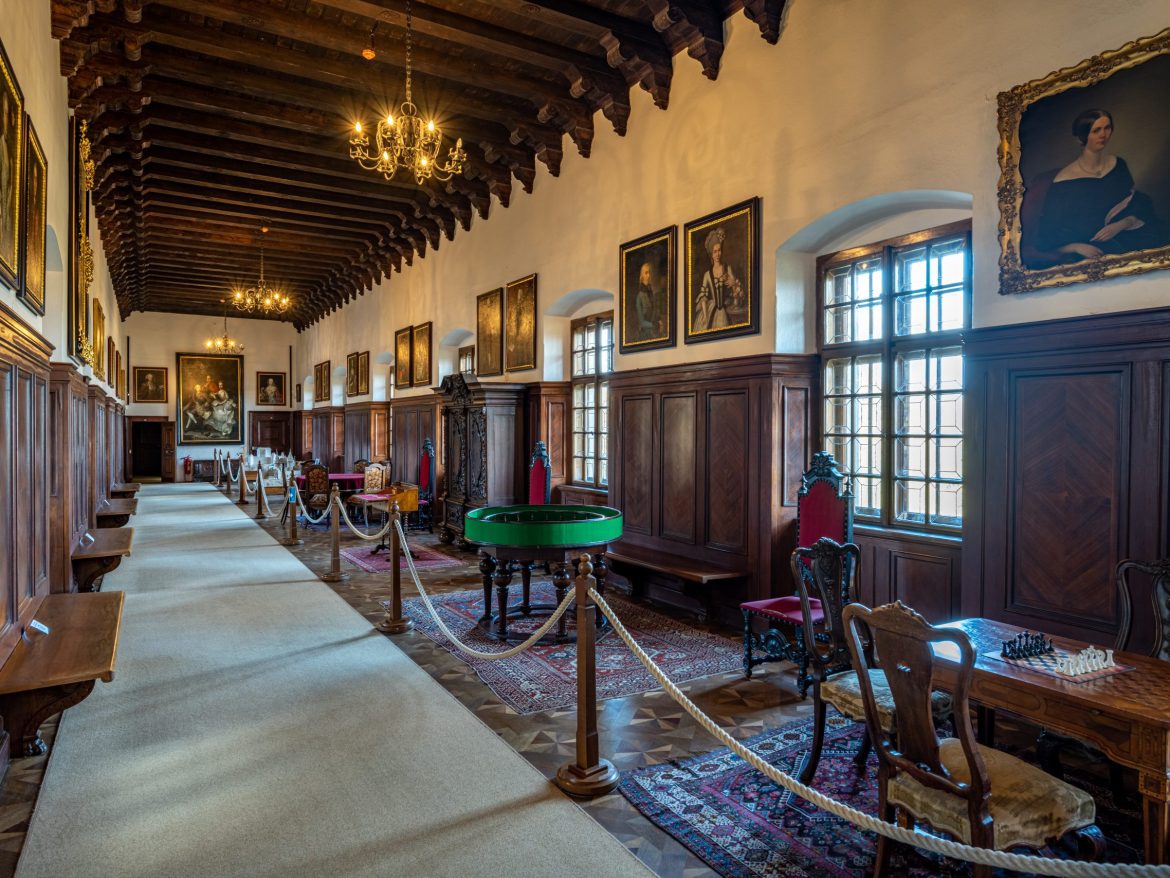
Two models of the castle are placed at the entrance to the room. They present two forms of Bojnice castle. The first is a theoretical image of the castle in the first half of the 17th century, based on Johann Ledentu's drawings from 1639. The second model represents the planned appearance of Bojnice castle after the completion of the rebuilding at the beginning of the 20th century. This plan could not be fully realised due to several delays, but mainly due to the death of count John Pálffy. The beamed ceiling, which you can see above, was built in 1905 by the Colli company. The first third or so from the entrance is a slightly different colour to the rest of the room. This is due to a fire in 1919.
The largest painting in the room is a triple portrait of king Louis XVI. of France, his wife Marie Antoinette and her brother Maximilian of Habsburg. The picture was painted in the 18th century by Johann Carl Auerbach. The parents of Marie Antoinette and Maximilian are on the sides of the painting, on the right queen Maria Theresa of Hungary and Bohemia and on the left emperor Francis I. Stephan of Lorraine.
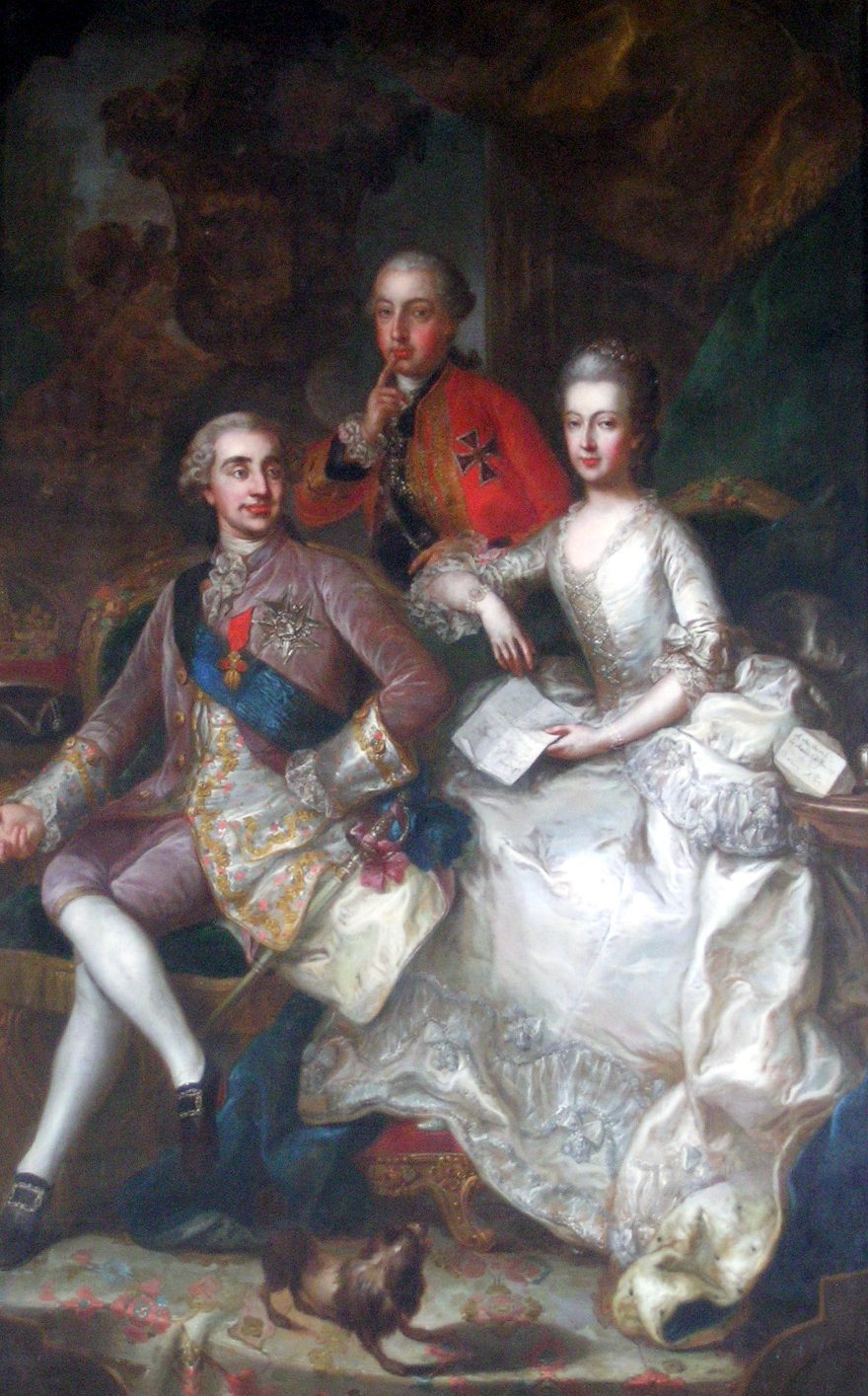
Marie Antoinette, Louis XVI., and Archduke Maximilian, Johann Karl Auerbach, oil on canvas, second half of the 18th century
The richly carved cabinet in the centre of the room was made in the Polish city of Gdaňsk in the 1700s. The coat of arms of this city can be seen at the top in the cornice of the cabinet. Opposite the cabinet is a portrait of the Holy Roman Emperor, King Joseph I. of Hungary and Bohemia. He is dressed in a theatrical costume from a performance of the equestrian ballet “La contesa dell' Aria e dell' Acqua” staged in Vienna in January 1667 to celebrate the wedding of emperor Leopold I. The picture was painted later, between 1685 and 1695, it depicts the son of Leopold I. and belongs to count Pálffy's original collection. The other portraits on the walls of the winter garden are part of the extensive collection of the family gallery of portraits of members of the Zay family from Uhrovec.
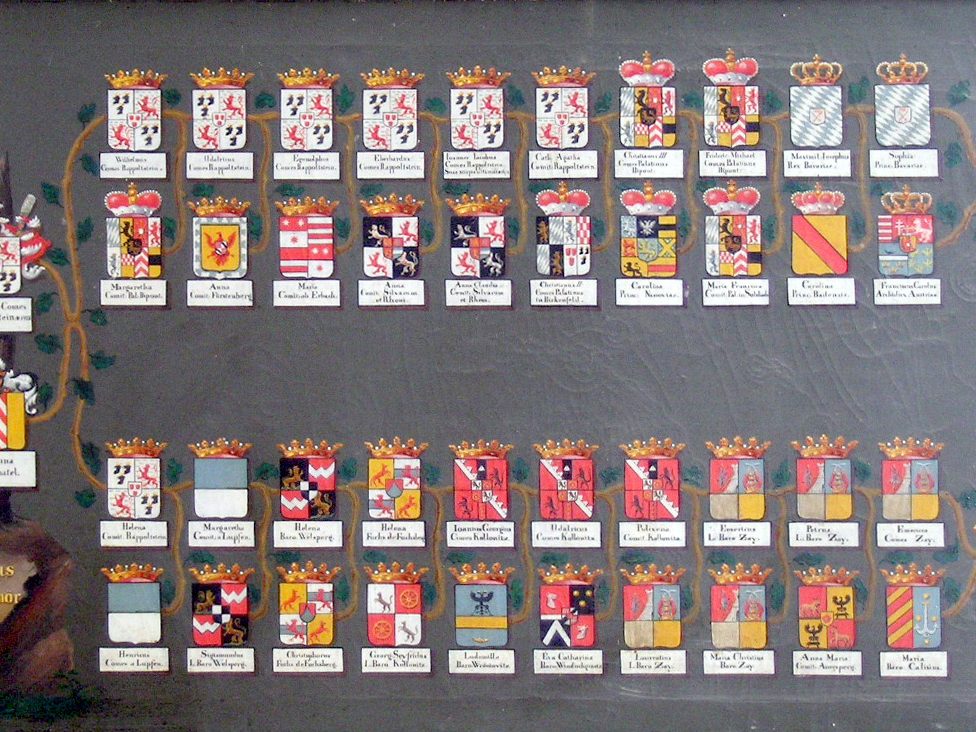
Family Tree of the Zay and Rappolstein Families, unknown artist, oil on canvas, first half of the 19th century
Also from the count's collection comes a table for the game of Tivoli, which was in this room during count John Pálffy's lifetime. On the top surface of the table there is a circular railing in the form of a balustrade, which borders the playing area with 100 pits numbered from 1 to 100. The game consisted in the player throwing the playing ball over the balustrade around the perimeter of the table, where it rolled down the table and into the numbered pit. The player who scored the most points in the agreed number of rounds won.